


Impact-oriented ventures can have an edge with investors
The days when tech startups could attract investors with promises of "changing the world" are long gone. Today, impact investors expect evidence of measurable, purpose-driven action—not just a few aspirational lines in a pitch deck. The companies thriving in the new impact landscape are those that translate their vision into tangible impact, delivering both societal value and financial returns. These ventures are proving that commitment to meaningful outcomes can drive profitability while capturing investor interest.
What is venture impact?
Impact is the effect a company has on the environment and society through a achieving a specific outcome.i Founders demonstrate their commitment to impact by delineating how they will conduct their business through alignment with the triple bottom line, a framework which considers how an organization addresses the planet, people, and profit. Because their business model prioritizes long-term resilience, they are derisked and prepared to create and protect value over the long-term. These ventures mitigate non-financial issues that could have a financial impact in the long term.ii
Impact investors value ventures with a strong narrative that clearly articulates impact, as it helps them to make investment decisions that generate positive and measurable results with societal and environmental benefits,iii with market returns supporting the triple bottom line.
We have discussed the challenges of the current VC landscape in previous posts — increasingly risk-averse investors are deploying capital more selectively, with a marked decrease in available funding. This dynamic has created an asymmetrical market where the balance of power tilts heavily in the investors’ favour.
In a landscape that may appear bleak, recognizing and capitalizing on opportunities to distinguish one’s venture makes all the difference. Impact can be that powerful differentiator.
In this challenging environment, some founders may be tempted to abandon their pursuits in search of more favourable conditions. However, shrewd founders recognize the importance of leveraging every differentiator they can to secure a competitive edge. We will consider where the opportunity lies for founders to differentiate themselves, and how founders can strengthen each element of their impact strategy to prove tangible de-risking to investors.
Subjectivities aside, focusing on impact is one way of objectively differentiating your venture for investors. However, as a consequence of the debates around it, an impact focus may invite additional scrutiny from investors, and thus warrant deeper diligent preparedness for investors.
The Opportunity
The opportunity for impact-oriented founders lies in tangible and purpose-driven action, not just as a few aspirational bullet points on a pitch deck. Debate around greenwashing has influenced legislation on how ESG (environment, social, and governance) metrics can be represented by businesses, creating additional challenges for new and established ventures. Risk-averse investors will screen diligently and perceive discrepancies between a venture’s mandates and demonstrated actions.
In tandem with screening for greenwashing comes a need for clearly defined measurement methods. The World Economic Forum (WEF) published a report where they categorized stakeholder capitalism into principles of Governance, Planet, People, and Prosperity,iv each aligned with corresponding United Nations Sustainable Development Goals (SDGs), a widely recognized method of assessing targets to address global challenges by 2030.v
Despite apprehension surrounding greenwashing claims, the market for impact investing exists, and it’s growing. According to the Global Impact Investing Network (GIIN) 2024 State of the Market Report, the impact investing market has expanded at 14% CAGR over the past five years.vi
This search for ways to clearly define what counts as a company’s impact presents both a challenge and an opportunity for founders: the challenge lies in measuring intangible aspects like social or environmental value, while the opportunity allows them to differentiate their business by demonstrating real, measurable contributions to stakeholders beyond profit, despite how elusive measurement can be.
By aligning their operations with metrics targeting Governance, Planet, People, and Prosperity, founders have the opportunity to enhance the non-financial aspects of their business and to position themselves to participate in the growing impact investing market, where investors increasingly use these metrics to evaluate opportunities and conduct due diligence.
Let’s look at three strategies as they correspond to impact that founders can use and what makes them so attractive to investors:
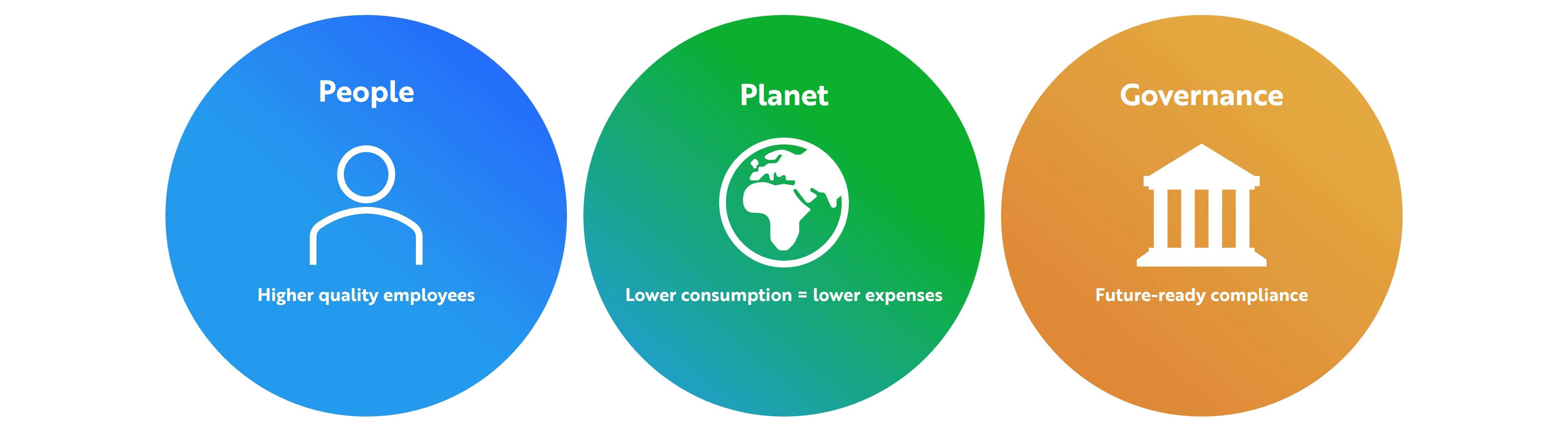
1. Planet: Founders can weave sustainability into their supply chain.
To implement a strategy that addresses impact upon the planet, founders can weave sustainability into their operations. This means having a target on their carbon footprint and creating a plan to reduce it, something that only 7% startups do.vii To do this, founders need to map out environmental risks that occur at different stages of their venture’s development — by analyzing the impact of your product or service in the world, and studying the environmental risks most prevalent in the sector in which your business falls in. One approach is a materiality assessment, which looks at different sectors and the most common sustainability challenges that befall businesses in those sectors.viii
Besides creating a positive impact in the world, building sustainability into your supply chain can increase the value of your business through cost reductions.ix For example, choosing options with lower energy consumption means lower expenses, while simultaneously reducing your contribution to natural resource depletion.
2. People: Founders can adjust their business model to empower all people the business touches.
Internally, founders can build a strong ‘people’ element into their impact strategy by fostering an inclusive workplace culture, ensuring fair labor practices, and investing in employee well-being and development.
Externally, founders can again use the materiality assessment to ascertain if their sector is at risk of disempowering stakeholders. Beyond that, all businesses can analyze and identify ways to give back and support their local communities.
For example, if you have identified that your business requires a large amount of manual labour to create your product or service, you could address the social impact of your venture by choosing to use local, well-regulated labour rather than global labour arbitrage that may be cheaper but often comes with dubious human rights alignment.
A strong people focus can help a founder attract and retain high-quality employees, reducing employee turnover and increasing job satisfaction. Building a sense of trust and purpose with employees creates a positive social impact, which in turn enables employees to perform in a prosocial way that positively advances the needs of the company, avoiding situations such as absenteeism and workplace sabotage, which directly impacts the bottom line.
3. Governance: Founders can make sure that their compliance is future-ready.
To address governance, founders can ensure their compliance mandates are prepared for the future by staying ahead of evolving regulations and adopting flexible frameworks. Diverse boards are the most visible indicator, which can be a metric addressed in early due diligence processes.x As regulatory landscapes continue to evolve, impact-driven ventures that prioritize governance risk assessment and mitigation are better equipped to anticipate and navigate evolving regulation, future-proofing their operations against governance challenges.
For example, if you have identified that a key part of your venture’s business model includes the collection and storing of data by AI, incorporating rigorous due diligence can include creating a standard around data privacy and security, creating an offense which is prepared to meet increased scrutiny on AI regulation — something that is presenting significant challenges for organizations that operate in Europe with the introduction of the AI Act.xi
Strong governance goes beyond following the law. It is acting with purpose and accountability, and assuming responsibility for how you operate in the world. For founders, leading in their sector creates opportunities for top-line growth — when regulatory authorities recognize that a company goes beyond the bare minimum to address sustainability, they are more likely to grant them access and government support that give opportunities for growth.
The (triple) bottom line
The individual elements of impact are deeply interconnected, with due diligence efforts and materiality assessments often addressing multiple facets at once. This holistic approach ensures that actions taken in one area — such as environmental stewardship — can enhance social impact and strengthen governance practices. Founders have a powerful choice: by embracing sustainability not just as a compliance requirement but as a core business strategy, they can build more resilient, forward-thinking companies. In doing so, they not only create stronger businesses but also contribute to a more sustainable and equitable world. The opportunity to lead with purpose is theirs to take — and the benefits, both financial and societal, will follow.
Identify your blind spots.
Understand how a prospective investor will assess your company, including your impact-driven: Tailwind's Check6™ process uncovers critical vulnerabilities and identifies the most significant risks that represent barriers to capital.
Footnotes:
i IRIS+. “An Introduction to Impact Measurement and Management | IRIS+ System,” n.d.
ii “What Is ESG and What Does It Mean for Your Business?,” BDC.ca, July 29, 2024.
iii The GIIN. “What You Need to Know About Impact Investing,” n.d.
v “THE 17 GOALS | Sustainable Development,” n.d.
vii Karen McCormick, “Enabling Start-ups to Measure and Improve ESG Performance,” ESG_VC, n.d.
x Bruce Simpson, “Startups Need an ESG Strategy,” Harvard Business Review, November 14, 2022.
xi PricewaterhouseCoopers. “EU AI Act: European AI Regulation and Its Implementation.” PwC, n.d.